The first 24 hours in a city often determine what travelers remember about it. A carefully planned day can include the main sights, but it should also leave time for a neighborhood café, a local ferry or a walk away from the busiest streets. In Copenhagen, Stockholm, Oslo and Bergen, those smaller choices provide a clearer introduction to the city and make a short port call feel like its own trip.
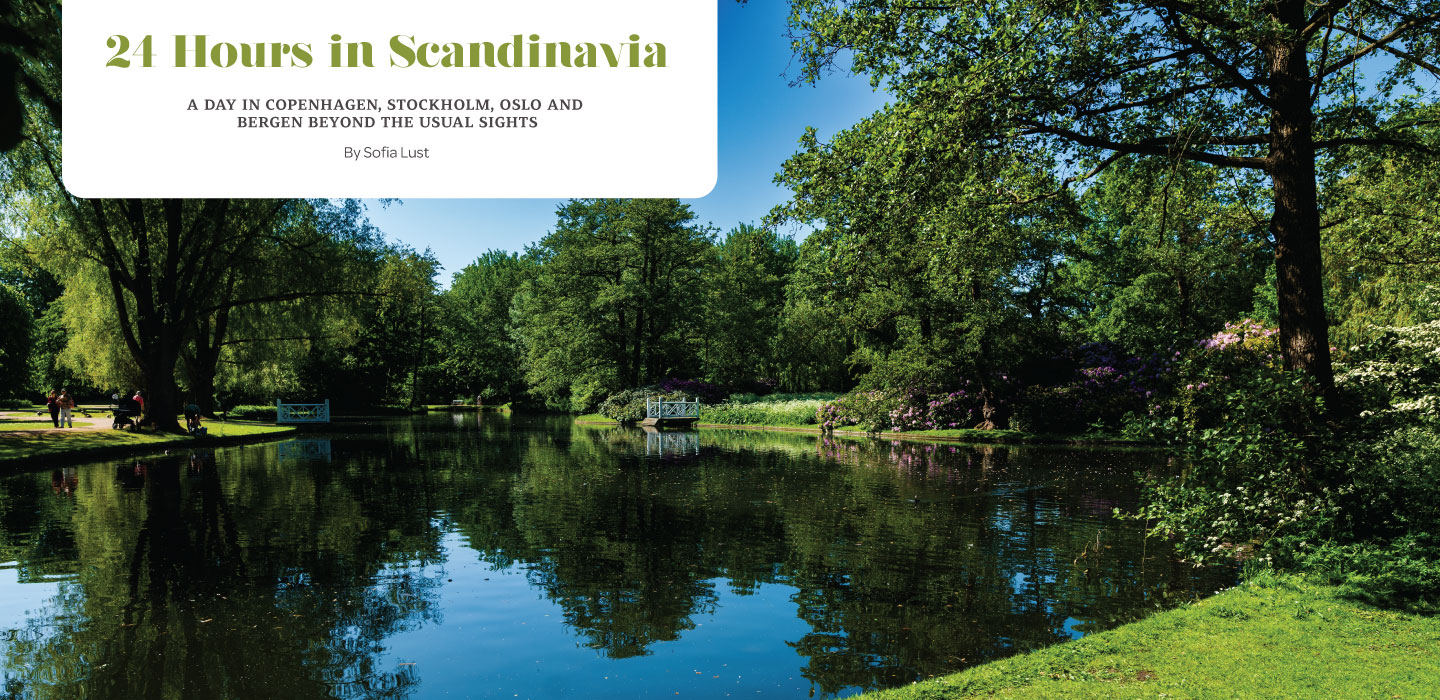
Copenhagen
Begin in Nørrebro, a diverse residential district northwest of central Copenhagen, and wander through Superkilen, a long public park divided into three distinct sections. It is filled with benches, signs, play equipment and other objects selected from countries connected to the people living nearby. Designed by Bjarke Ingels Group, commonly known as BIG, along with the art collective Superflex and landscape architecture firm Topotek1, the park combines sports courts, gathering areas and a green space used for picnics.
Stop for coffee around Jægersborggade, a cobblestone street known for its cafes, bakeries and independent shops, then rent a bicycle. The route to Frederiksberg, a municipality surrounded by Copenhagen, passes apartment buildings, schools and local businesses before reaching Søndermarken, a large public park beside Frederiksberg Palace.
Leave the bicycle near the park and go underground at Cisternerne, a former water reservoir beneath Søndermarken. The chambers once formed part of Copenhagen’s drinking water system, but they now hold a changing program of contemporary art. The temperature stays cool and the floors can be damp, so practical shoes are a must.
Afterward, walk to Værnedamsvej, a short cafe-lined street between Frederiksberg and Vesterbro, for lunch. Vesterbro is a former working-class district west of the city center that is now known for its restaurants, bars and independent stores. Continue through the neighborhood and finish near the harbor. Save Nyhavn, the “New Harbor,” Tivoli Gardens, Copenhagen’s historic amusement park, and the royal palaces for another part of the visit.
Stockholm
Start with the subway. Stockholm has placed art throughout the network. T-Centralen, the city’s main subway station, is the best-known example. Its Blue Line platforms have exposed rock walls painted with blue vines and floral patterns. Thorildsplan, a station in western Stockholm, has colorful tile designs inspired by early video games spread across its platforms and walls. A regular transit ticket also covers buses and several ferries, so one ticket can handle most of this route.
Continue to Södermalm, a large island district south of Stockholm’s Old Town, and walk Monteliusvägen, the elevated pedestrian path overlooking the city. The path is about 500 meters long and looks across the water toward Stockholm City Hall and Riddarholmen, a small historic island known for its church and former palaces.
From there, head to the ferry terminal and take a seasonal boat to Fjäderholmarna, a small group of islands close to central Stockholm. The nearest islands in the Stockholm archipelago can be reached in roughly half an hour. Ferries to Fjäderholmarna operate seasonally, so summer visitors have the widest choice of departures and return times.
Red wooden buildings near the dock contain craft studios, shops and places to eat. There is enough time for lunch and a short walk before returning to the city. Spend the late afternoon in Gamla Stan, the “Old Town,” but leave Västerlånggatan, the district’s main shopping street, after a few blocks. The smaller lanes near the water are quieter and show the old town’s irregular medieval street plan. Round up the evening with dinner in Södermalm.

Oslo
Walk to the ferry piers near City Hall and board a public boat to Hovedøya, whose name means “Main Island.” Standard public transportation tickets are valid on the island ferries.
Hovedøya is the closest island to central Oslo and has beaches, wooded paths and the ruins of a medieval Cistercian monastery. The ruins date to the 12th century, when monks from the Cistercian Catholic order established an abbey on the island. Make sure to stay on the marked trails because parts of Hovedøya are protected for their plants, wildlife and geology.
Back in the center, have lunch near the harbor and walk east. The route passes the Oslo Opera House, whose sloping roof is open to pedestrians, and MUNCH, a waterfront museum named after Norwegian artist Edvard Munch. Choose one museum and give it enough time.
Reserve a session at one of the floating saunas along the Oslofjord. Operators run them throughout the year. Visitors can alternate between the heated sauna and the cold water, although the dip is optional.
Finish at Ekebergparken, the Ekeberg Sculpture Park, which is reached by tram from the center. Its wooded paths include works by international artists and viewpoints over the harbor.
Bergen
Visit Bryggen, also called “The Wharf,” before its shops open. The former Hanseatic trading district is a UNESCO World Heritage site. Merchants from the Hanseatic League, a powerful medieval network of Northern European trading cities, used the wharf for centuries.
The harbor-facing row of wooden buildings is only part of the district. Enter the narrow passages behind the facades where workshops, galleries and small offices occupy buildings connected by uneven floors and steep staircases.
The Fløibanen, Bergen’s funicular railway, is a short walk away. Take it to Mount Fløyen, one of the seven mountains surrounding Bergen, then continue to Skomakerdiket, a small lake whose name means “Shoemaker’s Pond.” It is about 10 minutes from the upper station.
Instead of taking the funicular back, follow the walking route downhill. The descent passes through forest and residential streets before returning to the center.
For lunch, order fish cakes or fish soup at restaurant Søstrene Hagelin. The local business was founded by two sisters in 1929 and is known for traditional dishes made with fish.
Spend the afternoon at Bryggens Museum, an archaeological museum focused on medieval Bergen, or visit the small galleries around the wharf. Keep waterproof clothing close — Bergen’s rain does not require a new itinerary, but it does reward preparation.
Twenty-four hours will not cover an entire city, but it can still reveal the routes people take every day: the bicycle ride to an underground gallery, the subway trip that continues by ferry, the public boat to a nearby island or the path from a mountain into town. That is enough for one visit and a good reason to return.
A trusted travel advisor can help turn a short port call into a smoother, more complete Scandinavian journey. Book through our agency for expert guidance on choosing the right cruise line, itinerary and stateroom, coordinating pre- and post-cruise stays and planning experiences that fit your interests and available time. Your advisor can also identify available agency-exclusive offers and amenities and remains a reliable point of contact before, during and after the trip, helping manage the details so you can focus on the journey itself.